Ecommerce SEO Pricing: How Much Does It Cost in 2026?

Ecommerce SEO pricing in 2026 typically ranges from $500 to $7,500 per month for many businesses, although larger online stores and highly competitive industries may require significantly higher investments. The actual cost depends on website size, product catalogue, competition, technical requirements, content production, and the level of ongoing optimization.
For ecommerce businesses, investing in search engine optimization is about more than improving Google rankings. A well-planned SEO strategy helps potential customers discover products, explore category pages, compare options, and make purchases. It can also strengthen brand visibility across AI-powered search experiences, including ChatGPT and Google’s AI search features.
But how much should you actually pay for SEO? Should you hire an ecommerce SEO agency, work with an independent consultant, or choose a monthly SEO package?
In this guide, we’ll explain ecommerce SEO pricing models, average search engine optimization costs, the services included in professional SEO packages, and the factors that influence your budget. We’ll also explore AI Search Optimization and Generative Engine Optimization (GEO) costs and introduce Seovelix’s SEO packages for businesses looking to grow their online stores.
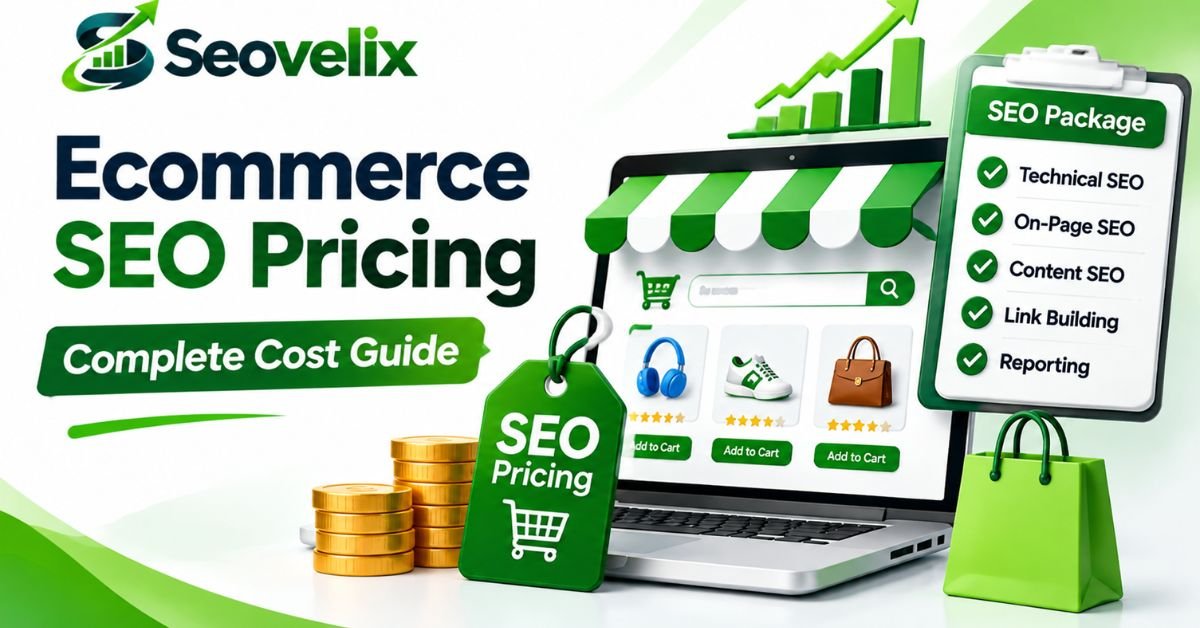
How Much Does Ecommerce SEO Cost in 2026?
Ecommerce SEO costs vary depending on the amount of work required and the experience of the SEO provider. A small online store with a limited product catalogue may need basic technical improvements and product page optimization. A large ecommerce website with thousands of products may require advanced technical SEO, content marketing, digital PR, and ongoing optimization.
As a general market benchmark, a WebFX survey of 250 US-based ecommerce businesses reported the following pricing ranges:
| SEO Pricing Model | Typical Cost |
| Monthly ecommerce SEO | 500–7,500 |
| Hourly SEO services | 25–100 |
| One-time SEO projects | 100–5,000 |
| Enterprise ecommerce SEO | Custom pricing |
These figures represent survey findings, not fixed industry rates. Actual search engine optimization prices vary by location, provider experience, website complexity, and deliverables.
For example, a small WooCommerce store may need keyword research, technical corrections, and product page optimization. A national ecommerce brand may require thousands of page improvements, competitive keyword targeting, advanced content clusters, and authority-building campaigns.
The important point is to evaluate what you receive for the SEO price, not simply choose the lowest monthly fee.
Ecommerce SEO Pricing Models: What Are Your Options?
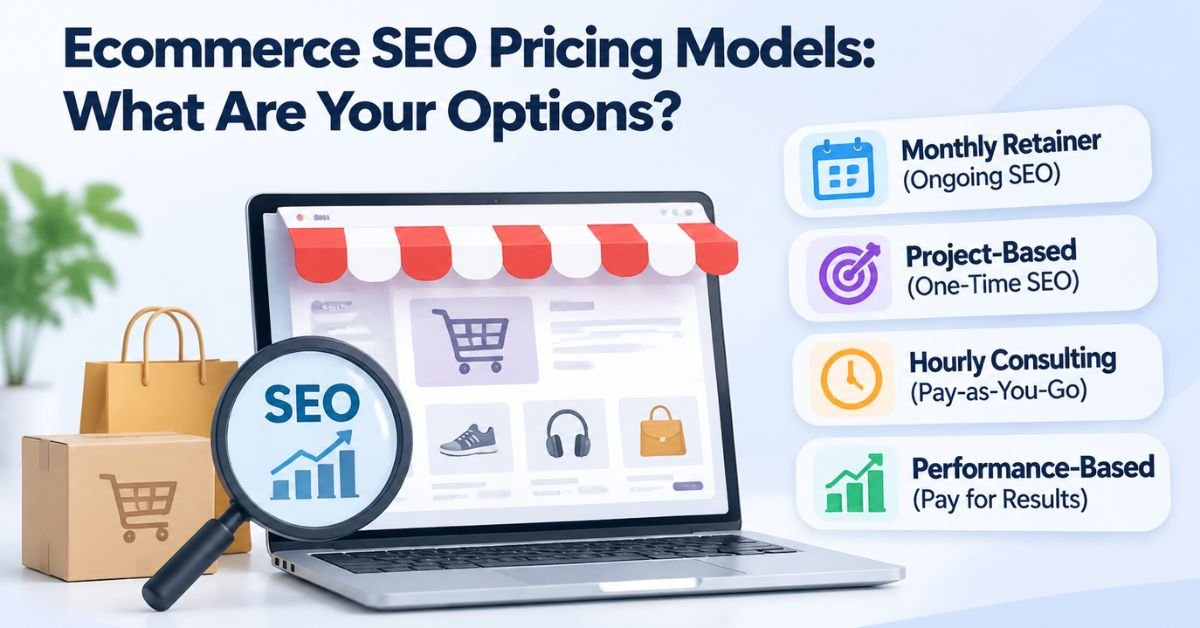
Different ecommerce SEO companies use different billing structures. Understanding these SEO pricing models helps you select an arrangement that matches your business goals and available budget.
1. Monthly Ecommerce SEO Retainer
A monthly retainer is one of the most common ways to pay for SEO. You agree to a recurring monthly fee in exchange for an agreed scope of ongoing services.
Depending on the package, ecommerce SEO services may include:
- Technical website audits and optimization.
- Ecommerce keyword research.
- Product and category page optimization.
- Content creation and content refreshes.
- Internal linking improvements.
- Quality backlink outreach.
- Schema markup implementation.
- Monthly performance reporting.
Monthly SEO is particularly useful for businesses that want consistent organic growth. Search optimization requires regular monitoring, content improvements, technical maintenance, and competitive analysis.
Who should choose it?
Growing ecommerce stores, established online retailers, and businesses that want a long-term SEO strategy can benefit from monthly retainers.
2. Hourly Ecommerce SEO Consulting
Hourly SEO consulting allows businesses to pay for specific expertise without committing to a complete monthly package.
An ecommerce SEO expert may help with:
- Technical SEO troubleshooting.
- Keyword and competitor research.
- Website migration planning.
- Product page optimization.
- SEO strategy development.
- Google Search Console analysis.
This model works well when your internal marketing team can implement recommendations but needs professional guidance.
However, hourly consulting may become expensive if your website requires continuous support. Before you pay for SEO by the hour, agree on the expected tasks, estimated hours, and final deliverables.
3. Project-Based Ecommerce SEO Pricing
Project-based SEO pricing involves paying a fixed fee for a clearly defined task or project.
Common examples include:
- Comprehensive ecommerce SEO audits.
- Shopify or WooCommerce SEO improvements.
- Website migration audits.
- Product and category page optimization.
- Technical SEO cleanup.
- Structured data implementation.
- Ecommerce keyword mapping.
This approach is useful when you have a specific SEO problem that does not require ongoing management.
For example, an online store preparing to migrate from WooCommerce to Shopify may hire an ecommerce SEO company to plan URL redirects, preserve existing rankings, review indexation, and prevent avoidable organic traffic losses.
The price depends on project scope, website size, technical complexity, and the number of pages involved.
4. Performance-Based SEO Pricing
Performance-based SEO pricing connects some or all of the payment to agreed performance indicators.
These arrangements may involve traffic growth, qualified leads, conversions, or revenue-related targets. Some providers combine a smaller fixed retainer with performance incentives.
However, this model requires careful evaluation. Rankings and organic revenue depend on several factors beyond an SEO provider’s control, including product pricing, inventory, competition, website usability, and market demand.
Be cautious of providers promising guaranteed first-page rankings or guaranteed sales. A reliable ecommerce SEO consultant should explain the strategy, measurement process, responsibilities, and limitations before starting.
Ecommerce SEO Pricing by Business Size
Your store’s size and growth stage have a direct impact on the amount of SEO work required.
Small Ecommerce Businesses
Small online stores usually have fewer products, limited category structures, and smaller marketing budgets.
Their SEO priorities may include:
- Basic technical SEO improvements.
- Keyword research for important products.
- Product title and description optimization.
- Category page improvements.
- Internal linking.
- Google Search Console setup.
- Content optimization.
A focused SEO strategy can help smaller stores establish organic visibility without paying for services they do not yet need.
Growing Ecommerce Stores
Growing stores typically have larger product catalogues, more competitors, and greater content requirements.
Their SEO campaigns may involve:
- Competitor gap analysis.
- Advanced keyword mapping.
- Product and category page optimization.
- Regular SEO articles.
- Technical SEO monitoring.
- Link building and digital PR.
- Conversion rate optimization.
- Content clusters and topical authority.
At this stage, businesses often benefit from working with experienced ecommerce SEO experts who can coordinate technical, content, and authority-building activities.
Large and Enterprise Ecommerce Websites
Enterprise ecommerce websites may contain thousands or millions of URLs across products, categories, variations, and international markets.
Their SEO requirements can include:
- Large-scale technical SEO audits.
- Crawl budget and indexation management.
- Faceted navigation optimization.
- International and multilingual SEO.
- Advanced internal linking.
- Programmatic SEO strategies.
- Large-scale content operations.
- Digital PR and authority development.
- Continuous monitoring and reporting.
These projects usually require multiple specialists and a customized SEO strategy. Consequently, enterprise ecommerce SEO pricing is generally higher than standard small-business packages.
What Factors Affect Ecommerce SEO Pricing?
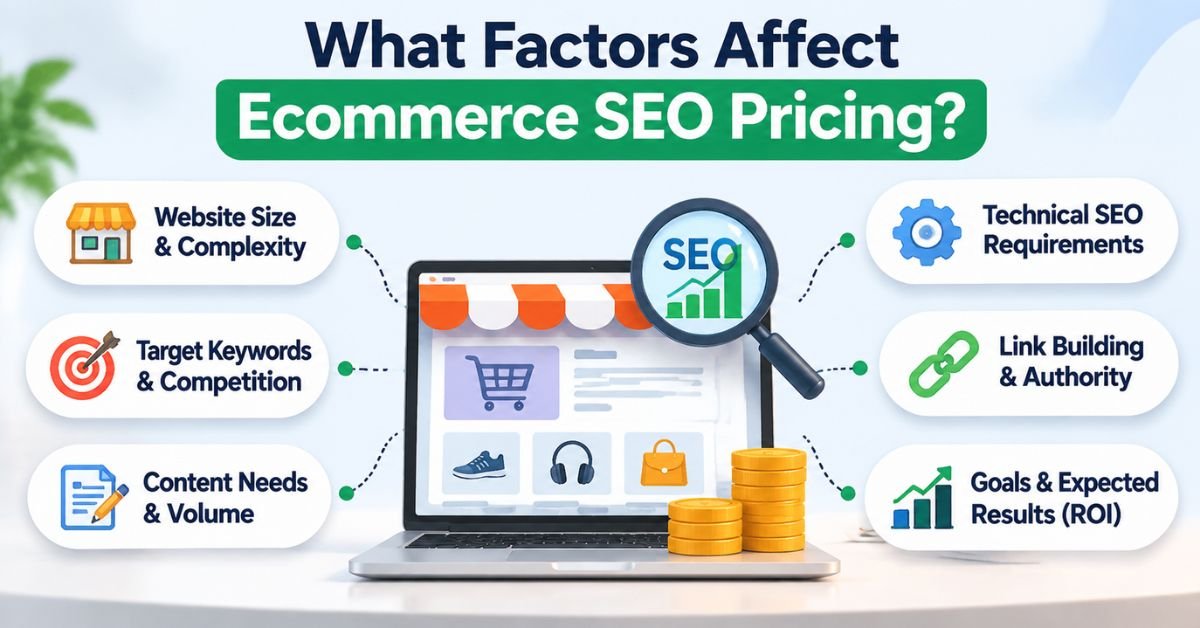
There is no universal ecommerce SEO price list because every online store has different optimization requirements. Several important factors determine how much you should budget.
1. Website Size and Product Catalogue
The number of products, categories, and URLs affects the amount of work required.
For example, optimizing 50 product pages is very different from managing 5,000 product pages. Larger catalogues require more keyword mapping, content reviews, internal linking, duplicate content management, and indexation monitoring.
2. Technical SEO Complexity
Technical problems can increase the cost of an ecommerce SEO campaign.
Common issues include:
- Duplicate product and category URLs.
- Incorrect canonical tags.
- Poor website architecture.
- Crawl and indexing problems.
- Slow page loading.
- Broken internal links.
- JavaScript rendering issues.
- Missing or incorrect structured data.
A store with significant technical problems may need a detailed audit and developer support before content optimization can produce its full value.
3. Keyword Competition and Industry
Some product categories are more competitive than others.
For example, ranking for a specific handmade product may require less effort than competing for popular electronics, furniture, beauty products, or fashion-related search terms.
Highly competitive markets often require stronger content, better product information, relevant backlinks, and consistent optimization.
4. Ecommerce Platform
Your ecommerce platform can influence SEO requirements and implementation costs.
Shopify: Optimization may involve collection pages, product templates, duplicate URLs, canonicalization, and app-related performance issues.
WooCommerce: A WooCommerce SEO consultant may work on WordPress performance, plugin conflicts, product taxonomies, schema, and website architecture.
Magento: Larger Magento stores may require more advanced technical support, particularly for complex catalogues, filters, and international websites.
Custom Ecommerce Websites: Custom platforms may require additional development resources for crawling, indexing, rendering, structured data, and content management.
5. Content Creation Requirements
Content is an important part of ecommerce SEO marketing services.
Your strategy may require optimized product descriptions, category introductions, buying guides, comparison articles, educational blogs, and frequently asked questions.
A business that needs four high-quality articles every month will have different content costs from a store that only needs existing pages refreshed.
6. Link Building and Digital PR
Building website authority requires time, research, outreach, and relationship development.
Quality link-building campaigns may include relevant industry publications, editorial placements, digital PR, and valuable resource content.
The quality and relevance of links matter more than simply acquiring a large number of backlinks.
7. AI Search Optimization Requirements
Traditional SEO is no longer the only consideration for ecommerce brands. Businesses are increasingly interested in how their products and brand information appear in AI-powered discovery experiences.
AI Search Optimization may require additional work involving structured product information, content clarity, entity consistency, brand authority, product feeds, and monitoring AI-generated recommendations.
These additional requirements can influence the total SEO budget.
Businesses can explore how ecommerce product visibility on Google works across Search, Images, and other Google surfaces.
What Services Are Included in Ecommerce SEO Pricing?
Before choosing an ecommerce SEO company, understand exactly what its package includes.
Technical SEO Audit
A professional audit identifies crawling, indexing, website architecture, performance, and structured data problems. It provides an action plan for resolving technical issues that affect search visibility.
Ecommerce Keyword Research
Keyword research identifies the search terms customers use when looking for products. It includes commercial, transactional, informational, and comparison keywords.
The goal is to match the right search intent with the right product, category, and content pages.
Product Page SEO Optimization
Product page optimization improves product titles, descriptions, headings, images, internal links, and relevant structured data.
Well-optimized product pages help search engines understand product information while giving shoppers the details they need to make purchasing decisions.
Category Page SEO Optimization
Category pages help customers explore related products. Optimization may include keyword targeting, descriptive introductions, heading structure, internal links, and improved navigation.
Ecommerce Content Strategy
A content strategy identifies the topics that support your products and customer journey.
This may include buying guides, comparison articles, product education, and topic clusters that strengthen topical relevance.
Schema Markup and Structured Data
Structured data helps search engines understand information about products, prices, availability, product variations, organizations, and other page elements.
For ecommerce websites, relevant implementations may include Product, ProductGroup, BreadcrumbList, and Organization structured data.
Link Building and Digital PR
Link building helps develop relevant website authority through editorial outreach, digital PR, and useful content.
Conversion Rate Optimization
SEO attracts visitors, but visitors also need a good experience to become customers.
CRO audits review product page layouts, calls to action, navigation, mobile usability, and purchasing friction.
Ecommerce SEO Pricing: Freelancer vs. Agency vs. In-House
Choosing the right SEO provider is just as important as deciding your budget.
| Factor | Freelancer | SEO Agency | In-House Team |
| Cost | Often flexible | Package-based | Salary and overhead |
| Expertise | Individual specialist | Multiple specialists | Depends on hiring |
| Scalability | Limited capacity | More scalable | Requires recruitment |
| Management | Direct communication | Account management | Internal management |
| Best for | Specific tasks | Ongoing SEO campaigns | Large operations |
Freelancer: A freelancer can be suitable for keyword research, technical audits, content optimization, or consulting. However, one person may not cover every aspect of a complex ecommerce campaign.
SEO Agency: An agency can provide access to technical SEO specialists, content strategists, link-building professionals, and account managers. This can be useful for businesses that need coordinated SEO support.
In-House Team: An internal team offers direct control over daily SEO activities. However, recruitment, salaries, software, training, and management can make this option expensive.
When comparing a seo company for ecommerce with independent providers, evaluate experience, transparency, reporting, deliverables, and the quality of the proposed strategy.
Ecommerce AI Search Optimization Cost: How Much Should You Budget?
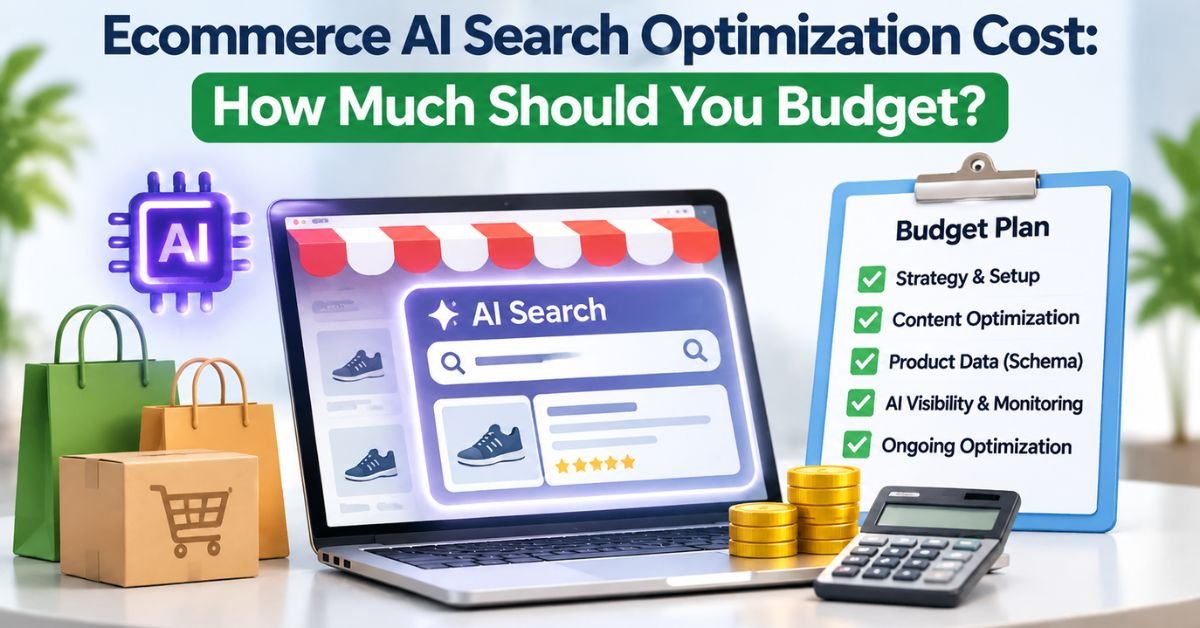
AI-powered search is creating new opportunities for ecommerce businesses to reach potential customers.
People increasingly use conversational tools to research products, compare features, understand product differences, and discover brands. As a result, ecommerce businesses are exploring AI Search Optimization alongside traditional SEO.
But what does AI SEO pricing for ecommerce actually involve?
Unlike traditional SEO, there is no widely established, standardized market price list for GEO services. The cost depends on the work involved, the number of products, the complexity of the website, and the number of AI discovery channels included in the campaign.
What Are Ecommerce GEO Services?
Generative Engine Optimization (GEO) focuses on improving how a brand’s information can be discovered, understood, and potentially referenced in generative AI experiences.
Ecommerce GEO services may include:
- Improving product descriptions and attributes.
- Strengthening brand and entity information.
- Developing helpful product comparison content.
- Improving factual consistency across the website.
- Reviewing structured product information.
- Optimizing content for clear answers to customer questions.
- Monitoring brand mentions and citations in AI platforms.
- Improving the quality and consistency of product feeds.
Generative Engine Optimization for ecommerce should complement technical SEO, content quality, and product data management. It is not a replacement for traditional search optimization.
How Much Does Ecommerce GEO Cost?
The answer depends on whether you need a basic AI visibility assessment or a comprehensive optimization campaign.
For example, a small store may initially need a review of its product information, brand descriptions, important landing pages, and existing content.
A larger ecommerce brand may need product catalogue improvements, entity research, content restructuring, digital PR, AI visibility monitoring, and ongoing reporting.
These projects should be scoped individually. An agency should explain which deliverables are included rather than charge a vague additional AI optimization fee.
How Much Does AI SEO Cost for Ecommerce?
AI SEO costs depend on the level of service required.
A basic engagement may focus on content and entity improvements. A more advanced campaign may include:
- AI search visibility benchmarking.
- Product and category content optimization.
- Brand entity and authority development.
- Product data and structured information reviews.
- Generative search content strategy.
- AI mention and citation monitoring.
Some of these activities overlap with traditional ecommerce SEO. Businesses should avoid paying twice for the same deliverable under separate SEO and GEO labels.
How to Improve Ecommerce Visibility in ChatGPT?
If you want to improve the chances of your ecommerce products being discovered or mentioned in ChatGPT, focus on making your product and brand information useful, accurate, and consistent.
Start with these practices:
- Write original and informative product descriptions.
- Include accurate product specifications and attributes.
- Publish helpful product comparisons and buying guides.
- Maintain consistent brand information across trusted sources.
- Build relevant editorial mentions and industry authority.
- Keep product prices and availability accurate.
- Make important website content accessible to search engines.
- Review how AI platforms describe your brand and products.
How to Get Ecommerce Products Mentioned by AI?
There is no guaranteed method to make ChatGPT or another AI platform recommend a particular product.
However, you can strengthen your product’s discoverability by improving its information quality, website accessibility, brand credibility, and presence across relevant sources.
Google also recommends maintaining strong SEO fundamentals for its generative search experiences. Its guidance highlights useful content, technical accessibility, and accurate ecommerce information. Product structured data and Google Merchant Center feeds can also help Google understand product details.
For this reason, Ecommerce Brand Visibility in AI Search should be approached as a long-term optimization objective rather than a guaranteed placement service.
How to Choose the Right Ecommerce SEO Package
Selecting an SEO package should start with your business requirements, not the cheapest available price.
Consider these factors before making a decision.
1. Define your business goals. Decide whether you want more organic traffic, product visibility, qualified visitors, sales, or brand awareness.
2. Evaluate your website. Review your product catalogue, technical health, category structure, indexing, and current organic performance.
3. Compare deliverables. Check whether the package includes technical optimization, keyword research, content, link building, and reporting.
4. Review the provider’s experience. Look for ecommerce experience and familiarity with your specific platform.
5. Understand the reporting process. Your provider should explain what is measured and how campaign progress is evaluated.
6. Avoid unrealistic promises. No trustworthy ecommerce SEO expert can guarantee a specific Google ranking or a fixed amount of revenue.
The right package should match your current needs while leaving room to scale as your store grows.
Seovelix Ecommerce SEO Pricing and Packages
At Seovelix, we help businesses improve organic visibility through strategic SEO, technical optimization, content development, and search marketing.
Our packages are designed for different business stages and marketing requirements. If you are looking for ecommerce SEO services, we can discuss your website, product catalogue, competition, and growth objectives to determine the most appropriate scope.
1. SEO Starter – $499/Month
Build a strong foundation for your website online presence.
SEO Starter is designed for businesses that need essential SEO improvements and a clear starting strategy.
Included services:
- In-depth technical website audit.
- Keyword research for high-ROI targets.
- On-page optimization, including metadata and images.
- Google Search Console setup.
- Google Business Profile setup and starter optimization.
- Existing content refresh for up to five pages.
- Consistent NAP social profile setup.
- Monthly performance reporting.
This package is suitable for smaller businesses that want to establish their organic search foundation.
2. Performance Growth – $999/Month
Accelerate organic traffic, leads, and business growth.
Performance Growth includes everything in SEO Starter, plus:
- Competitor gap analysis.
- Content strategy with two high-quality articles.
- Major Google Search Console error fixes.
- Full Google Business Profile optimization.
- Quality backlink outreach.
- Nine high-quality social posts, including reels.
- Schema markup for rich snippets.
- Conversion Rate Optimization audit.
This package is suitable for businesses that have established their SEO foundation and want to expand content, improve authority, and compete for more valuable search terms.
3. Market Domination – $1,499/Month
Build authority and strengthen your competitive position.
Market Domination is designed for businesses seeking more comprehensive optimization and ongoing growth.
Included services:
- Everything in the Performance Growth scope.
- Advanced content clusters for topical authority.
- Four high-quality SEO articles per month.
- Strategic PR and link building.
- Advanced ecommerce SEO, if applicable.
- Eighteen high-quality social posts, including reels.
- Quarterly technical audits.
- Strategy calls and monthly explanatory reports.
- Priority support with an SEO expert.
This package is intended for businesses with more ambitious organic growth requirements and a need for broader content and authority-building support.
Which Seovelix package is right for your ecommerce store?
If you are starting out, SEO Starter can help establish your foundation. If you need more content and competitive growth, Performance Growth may be a better fit. If your business requires advanced content clusters, authority development, and ecommerce SEO support, Market Domination may be worth considering.
The exact ecommerce implementation scope should be confirmed during consultation so the selected package matches your website’s actual requirements.
Ready to improve your ecommerce search visibility?
Get in touch with Seovelix to discuss your website, SEO goals, and the right strategy for your budget.
Get a Free SEO Consultation.
How to Calculate the ROI of Ecommerce SEO
Ecommerce SEO should be evaluated based on business performance, not rankings alone.
Several metrics can help you understand whether your investment is generating value:
- Organic search traffic.
- Organic conversion rate.
- Revenue from organic search.
- Average order value.
- Customer acquisition cost.
- Organic leads and transactions.
- Return on SEO investment.
A simple ROI formula is:
SEO ROI = [(SEO-attributed profit − SEO investment) ÷ SEO investment] × 100
For example, imagine an ecommerce store invests $1,000 per month in SEO and later generates $4,000 in additional organic-search-attributed profit during a measured period.
Its illustrative ROI would be:
($4,000 − $1,000) ÷ $1,000 × 100 = 300%.
This is a simplified example, not a guaranteed outcome. Businesses should account for profit margins, attribution, implementation costs, and the time required for SEO improvements to generate results.
How Long Does Ecommerce SEO Take to Show Results?
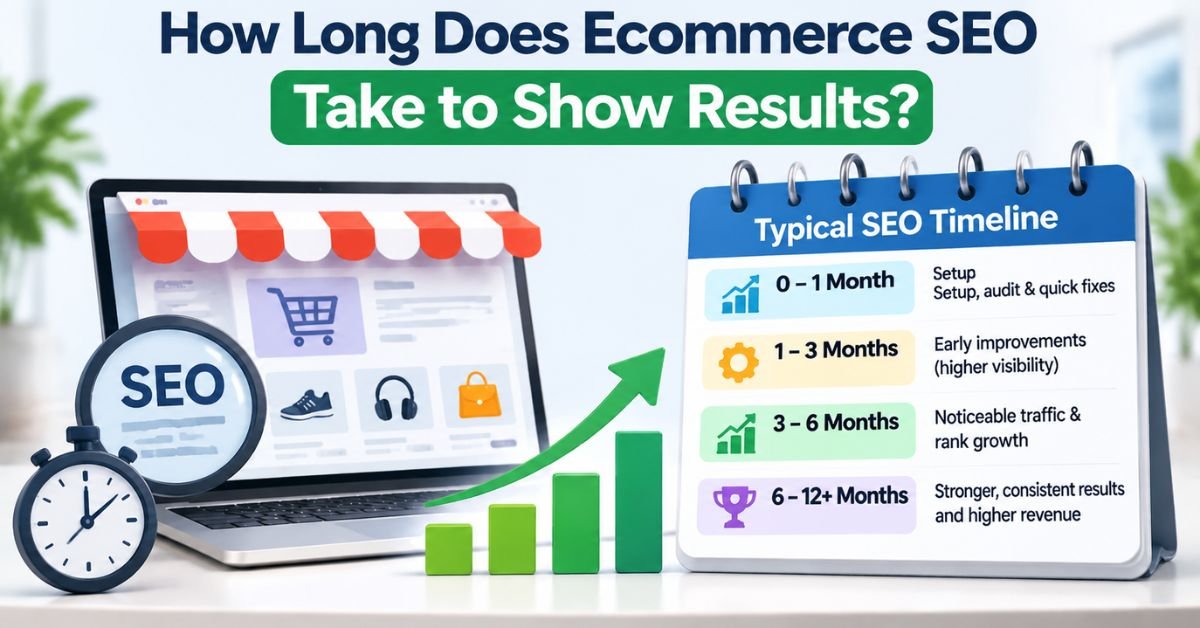
Ecommerce SEO is a long-term growth strategy. The time required to see meaningful improvements depends on your website’s current condition, competition, content quality, technical issues, and optimization efforts.
Some technical corrections can improve crawling and indexing conditions relatively quickly. However, stronger organic rankings, improved topical authority, and consistent sales growth generally require ongoing work.
A typical ecommerce SEO campaign may involve:
- Initial stage: Website audits, keyword research, technical fixes, and strategy development.
- Development stage: Product optimization, category improvements, content creation, and internal linking.
- Growth stage: Authority building, content expansion, and ongoing performance improvements.
- Continuous stage: Monitoring, testing, updating, and refining the strategy.
There is no universal timeline or guaranteed ranking outcome. A professional ecommerce SEO company should establish realistic milestones and measure progress using relevant business metrics.
Frequently Asked Questions About Ecommerce SEO Pricing
1. How much does ecommerce SEO cost per month in 2026?
Ecommerce SEO can cost approximately $500 to $7,500 per month for many businesses, based on published survey benchmarks. Larger websites and competitive industries may require higher budgets. The final cost depends on technical complexity, catalogue size, content needs, and service scope.
2. What is the average cost of ecommerce SEO services?
There is no single universal average. Published ecommerce pricing surveys show a broad range of monthly retainers, hourly rates, and project fees. Compare providers based on deliverables, experience, and the actual work required rather than relying on one average figure.
3. Is ecommerce SEO more expensive than traditional SEO?
It can be. Ecommerce websites often have larger product catalogues, category structures, duplicate URL challenges, product variations, and complex internal linking requirements. These additional technical and content requirements can increase the amount of SEO work.
4. How much should a small ecommerce business spend on SEO?
A small ecommerce business should choose a budget based on its current website condition, competition, and growth goals. A focused package that covers technical SEO, keyword research, and important product pages may be a sensible starting point.
5. How much do ecommerce SEO agencies charge?
Agency fees vary by location, experience, deliverables, and campaign complexity. Some providers offer entry-level monthly packages, while enterprise campaigns may require customized budgets. Always request a clear breakdown of services and reporting.
6. Is hiring an ecommerce SEO freelancer cheaper?
Freelancers may offer more flexible pricing because they usually operate with lower overhead. However, they may not provide the full range of technical, content, and link-building services available through a specialized agency.
7. What is included in an ecommerce SEO package?
A typical package may include technical SEO audits, keyword research, product and category optimization, content development, internal linking, structured data, link building, and performance reporting. The exact deliverables depend on the provider and package.
8. How much does Shopify SEO cost?
Shopify SEO costs depend on store size, product catalogue, competition, and technical requirements. Services may include collection page optimization, product metadata, URL reviews, duplicate content management, structured data, and content strategy.
9. How much does ecommerce GEO cost?
Ecommerce GEO pricing is not standardized. Costs depend on whether the engagement includes an AI visibility audit, product content improvements, entity optimization, digital PR, structured information, and ongoing monitoring.
10. How much does AI SEO cost for ecommerce?
AI SEO costs depend on the scope of traditional SEO and AI visibility work. A basic engagement may focus on content and brand information, while a broader campaign may require product data improvements, authority development, and AI visibility monitoring.
11. How can I get my ecommerce products mentioned by ChatGPT?
Improve product information, publish useful comparison content, maintain accurate product details, strengthen brand credibility, and make your website accessible to search engines. No agency can guarantee that ChatGPT will mention or recommend a particular product.
12. Is ecommerce SEO worth the investment for small businesses?
Ecommerce SEO can be a valuable investment for small businesses that want to build sustainable organic visibility and reduce dependence on paid advertising. Its value depends on product demand, competition, website quality, profit margins, and consistent implementation.
Final Thoughts: Invest in the Right Ecommerce SEO Strategy
Ecommerce SEO pricing in 2026 depends on much more than the number of keywords you want to target. Your product catalogue, technical website structure, competitive environment, content requirements, and growth goals all influence the investment.
Whether you need a basic SEO foundation or a comprehensive ecommerce growth strategy, focus on the quality of the work, transparency of deliverables, and measurable business outcomes.
As AI-powered discovery continues to develop, ecommerce brands should also consider how their products and brand information appear across traditional search engines and generative search experiences.
Seovelix offers SEO packages starting at $499 per month, with additional options for businesses that need broader content, authority-building, and ecommerce SEO support.
Want to find the right SEO investment for your online store? Contact Seovelix today and get a free SEO consultation.

2 thoughts on “Ecommerce SEO Pricing: How Much Does It Cost in 2026?”